
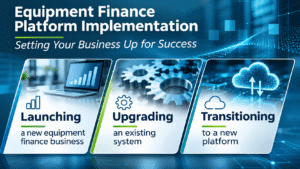
Implementing a new equipment finance platform is a significant undertaking. Whether an organization is launching a new equipment finance business, upgrading its existing system, transitioning to a new platform, or modernizing its operations, the process involves much more than installing software. It requires careful planning, coordination, and an understanding of how technology supports the day-to-day demands of equipment finance.
A successful implementation can help position an organization for greater efficiency, improved workflows, and future growth. However, getting there requires the right preparation, resources, and expertise.
Why Equipment Finance Platform Implementations Require Careful Planning
Equipment finance platforms support critical business functions, from contract administration and portfolio management to general ledger entries, billing, and reporting. Because these systems are often deeply integrated into daily operations, implementation decisions can have a lasting impact on the business.
Every organization has its own processes, data requirements, reporting needs, and operational priorities. A platform implementation must account for these differences while ensuring that the system is configured to support the organization’s business objectives.
Without adequate planning, organizations may encounter unexpected challenges, delays, or disruptions that extend beyond the implementation itself.
Key Considerations for a Successful Implementation
1. Define business requirements and objectives
Before implementation begins, it is important to identify what the organization needs the platform to accomplish. This includes defining the functionality and reporting capabilities required to support business operations.
Clear objectives help guide implementation decisions and establish a framework for measuring success.
2. Prepare for data migration and validation
Moving data from one equipment finance platform to another requires careful planning and a thorough understanding of the destination platform. Table structures, field names, and database relationships can differ significantly, making it essential to map each data element to the appropriate destination.
Data mapping involves more than matching field names. Field types, character limits, data formats, and required values must also be evaluated to ensure information transfers accurately and is compatible with the new platform.
Organizations should also decide early what data to convert, such as how much payment history to bring over and whether to include closed contracts, and clean up legacy data before migration rather than carrying errors into the new platform.
Thorough testing and validation are equally important. Verifying data accuracy, completeness, and relationships helps prevent data loss and downstream issues affecting billing, reporting, portfolio management, and other critical business functions.
3. Configure and integrate the general ledger
General ledger configuration is critical because it determines how contract activity is translated into the organization’s financial records. The process should align the chart of accounts, accounting policies, products, transaction types, and reporting requirements, then map key events—such as bookings, billings, payments, accruals, modifications, and terminations—to the correct accounts and periods.
Integration with the general ledger or ERP system should address journal detail, frequency, interface controls, error handling, and reconciliation with the servicing subledger. Accounting, operations, and technology teams should test representative scenarios and reconcile balances before go-live. Errors can cause misstated results, delayed closes, audit concerns, and extensive manual corrections, making this a core implementation workstream.
4. Determine the sales/use/property tax approach early
Sales, use, and property tax are often one of the most challenging areas for lessors, and questions tend to continue well beyond go-live. Because tax treatment affects billing, contract setup, accounting, and reporting, the approach should be discussed and determined early in the implementation rather than left until late in the project.
Key decisions include:
- Tax engine or integration: Decide whether the platform will integrate with a third-party tax solution such as Vertex, Avalara, or CCH, or whether tax will be handled through internal configuration and processes.
- Tax rules and setup: Define how jurisdictions, tax codes, exemptions, and certificates will be maintained, and how taxability is determined for different products, assets, and transaction types.
- Billing and accounting impact: Determine how taxes are calculated, billed, collected, and recorded, including how tax flows to the general ledger.
- Property tax: Establish how property tax assessments, filings, and billbacks to customers will be tracked and managed.
- Reporting and compliance: Identify the reports and data needed for tax returns and audit support, and who owns ongoing tax questions and changes.
Addressing these items early helps avoid rework in configuration, interfaces, and testing, and reduces compliance risk after the platform goes live.
5. Evaluate existing workflows and processes
An implementation provides an opportunity to review current processes and determine whether they should be retained, refined, or redesigned. Understanding how teams use the existing system can help identify potential inefficiencies and ensure that the new platform supports practical, sustainable workflows.
6. Plan for testing and user readiness
Testing should go beyond confirming that the software functions as expected. Organizations should validate real-world business scenarios, such as:
- Billing and Payment Application
- Accounting Entries
- Contract Changes
- Asset Events
- Renewals and Terminations
- Interfaces
- Reporting
- Security Roles
Well-designed acceptance criteria connect each test to a policy, reconciliation requirement, or expected servicing outcome.
Training and preparation are equally important. Ensuring that employees understand the new system and their role in the transition can help reduce uncertainty and support adoption.
7. Plan the cutover, go-live, and post-go-live support
Going live is an important milestone, but it is not the end of the implementation process. Organizations need a plan for addressing questions, resolving issues, supporting users, and stabilizing operations as the new platform becomes part of everyday business.
Several go-live decisions deserve particular attention:
- Cutover timing: Determine when the cutover will occur, and avoid quarter-end and year-end where possible. These are critical, intensive periods for accounting, reporting, and portfolio activity, and a conversion during them adds risk and strains the same teams supporting the implementation.
- Parallel processing: Decide whether to run the legacy system and the new platform side by side. Comparing outcomes such as billings, accounting entries, and balances can confirm that the new platform performs as expected before the legacy system is retired.
- Booking freeze: Consider a freeze on new bookings during the conversion period. Limiting changes to the portfolio while data is migrated and validated helps keep the source and destination data aligned and simplifies reconciliation.
- Legacy-to-new platform reconciliation: Reconcile the legacy system to the new platform at conversion, covering key balances such as net investment, receivables, unearned income, and residuals. Documenting and resolving differences before go-live helps ensure the new platform opens with accurate, supportable balances.
- Post-go-live stabilization: Plan for a defined hypercare period covering the first billing run, first month-end close, and first year-end cycle, when issues are most likely to surface.
Access to knowledgeable support during and after the transition can help organizations address challenges efficiently and maintain operational continuity.
The Value of Experienced Implementation Support
Even with a strong internal team, implementing an equipment finance platform can place significant demands on existing resources. Employees must often balance implementation responsibilities with their regular operational duties.
Experienced implementation support can provide additional capacity, technical knowledge, and practical insight into the complexities of equipment finance operations. This assistance can help organizations navigate configuration, testing, data validation, process transitions, and other implementation activities.
For organizations planning to outsource portfolio servicing, involving the servicing provider in the implementation process can be especially beneficial. Having the provider lead or participate in the implementation helps ensure that system configuration, data mapping, workflows, and reporting requirements align with ongoing servicing needs. This collaboration can help minimize transition challenges and establish a smoother path from implementation to day-to-day portfolio operations.
Ultimately, the right support model depends on the organization’s internal capabilities, the complexity of the project, and the level of assistance needed. Some organizations may need targeted expertise for specific phases, while others may benefit from more comprehensive support throughout the transition.
Building a Strong Foundation for the Future
A platform implementation is more than a technology project. It is an opportunity to strengthen operational processes, align technology with business goals, and prepare the organization for what comes next.
With thoughtful planning, clear communication, thorough testing, and the right expertise, organizations can approach implementation with greater confidence and establish a stronger foundation for long-term success.
For equipment finance organizations, having a knowledgeable partner throughout this process can make a meaningful difference—not only in navigating the implementation itself, but also in preparing for the operational demands that follow.